Sunday, June 13, 2021

Wasaga Shores

The first time I wrote a poem was in 2016.  I was working on a certificate in Creative Writing, and one of the mandatory courses was called Reading for Creative Writing. Naturally, it ended up being heavily weighted to poetry šŸ˜. When it came time to submit a poem as an assignment, I turned to the shores of Wasaga Beach for inspiration.

Gull soars over Wasaga Beach at sunset
The fiery reds and flaming oranges of Wasaga sunsets are breathtaking. I thought of them while writing "Wasaga Shores."
Wasaga Beach sunset

Wasaga Shores

on the sandy passage to shallow water
under the cardinal sunset sky
the honey sweet scent of balsam poplar

endless firmament
pin cherry berry red
sundown, luscious to the eye

trembling aspens quiver
slight waves crest
the rise and fall of reliable measure

elysium
Wasaga Beach sunset through the trees
At a time when mindfulness is promoted as a way to be fully present in a moment, as a way to relax the body and mind, and as a way to reduce stress, I realize that my best (and maybe only) mindful moments happen when I am standing by the water watching the sun go down. Every sunset is different and holds my attention completely. Here are a just few of the sunset pictures I've taken during years of visits to the beach.
A place for peaceful reflection
Wasaga Beach, Ontario

A calming pastel sky, Wasaga Beach

Drama in the clouds, Wasaga Beach

Serene moment on the shore
Wasaga Beach, Ontario

Tranquility by the water
Wasaga Beach, Ontario
After I finished my mandatory creative writing course, I quickly put the poetry away. I was no poet, and I was glad to be done with it. But, I held on to "Wasaga Shores." It was a bit of personal creative expression that I was (and am) very happy with.

When I discovered an unexpected interest in poetry earlier this year and challenged myself to write about my garden and the natural world that moves me, I knew that I would share the poem that started it all.
Wasaga Beach paddleboarder at sunset
Here's hoping that you find your "Wasaga Shores", like I did mine.

Happy Gardening!

Tuesday, June 8, 2021

A Shower of Acorns on the Cottage Roof

The summers in southern Ontario are all too brief. By the time the last chance of frost has passed in mid- to late-May, there are just four short months before the danger of a first frost in early to mid-October. Needless to say, there is a mad scramble to enjoy the fleeting heat and blazing sunshine to the fullest.

Seagull enjoying the spectacular
views at Wasaga Beach
I am very lucky to be able to spend some of my summer weekends on the sandy shores of Wasaga Beach. Five years ago, I realized a dream I didn't even know I had until it came true: the purchase of a modest cottage that became my family's beach-town retreat. It allows us to spend time away from the chaos of the city and in the outdoors enjoying nature.

Cottage through the trees
All around the cottage, the air is filled with the sound of birds and insects. In the distance, on a breezy day, it's easy to hear the waves crash to shore. Overhead, in the towering oaks, the leaves rustle and the squirrels chirp. Depending on the time of year, the sound of falling acorns bouncing off the cottage roof is unmistakeable.  All of these sounds inspired a poem.

A Shower of Acorns on the Cottage Roof

A shower of acorns

—bonk, bonk, bink-bonk—

on the cottage roof

A skitter-scatter of squirrel feet

Cottage country sun 

rises on late summer’s morning dew

Blue jays squawk

Crows caw and coo


A shower of acorns

—bonk, bink-bonk, bink—

on the cottage roof

A pitter-patter of chipmunk feet

Cottage country winds

roar across the bay

Rat-a-tat-tat, red-bellied woodpecker pecks

Chickadee-dee-dee welcomes the day


A shower of acorns

—bonk, bonk, bink-bonk—

on the cottage roof

A bumpety thump bump of rabbit feet

Cottage country waves

reach for the shore

Loons hoot, gulls screech

Dog scritch-scratches at the screen door


A shower of acorns

—bonk, bink-bonk, bink—

on the cottage roof

Dragonflies flutter in the breeze

Cottage country mosquitoes

buzz, buzz, buzzing in my ears

In the quiet of nature so serene

it's a wonder the humans get any sleep


A wild rabbit in Wasaga Beach
Happy Gardening!

Wednesday, June 2, 2021

Ludwig: A Love Story

Lilac "Ludwig Spaeth" was absolutely spectacular in the garden this year with its abundant flowers and outstanding fragrance.


Lilac "Ludwig Spaeth"
Given full sun, lilacs bloom reliably every spring for about three weeks. The flowers usually appear in mid-May and fade by early June. These hardy shrubs symbolize many things. Their flowers are often interpreted as symbolic of new beginnings and of renewal thanks to their early bloom time. Lilacs also symbolize love and romance. They are the flower given to couples on eighth wedding anniversaries. 

Lilacs also have a connection to death. Purple is the colour of mourning in many countries. During the Victorian era, widows wore lilacs as a sign of remembrance. 

The lilac in my backyard is named for Franz Ludwig SpƤth (1793-1883), a German botanist. As I thought about this man and all things associated with lilacs during the fleeting moments when they are in bloom, a love story started to take shape. The resulting poem is written as a ballade.*


Ludwig: A Love Story


Ludwig sends me lilacs every month of May

remembering like the earth remembers the seasons

Lilacs that he planted to mark the vows of our wedding day

persuading me I would one day be grateful for his reasons

Spring’s sweet scent, he dreamed, to our windows would breeze in  

Fragrant remembrances of moments we had only begun to accrue 

Life together was fresh, new, and easy, and so I teased him

Thank you for the flowers Ludwig, but I would much rather have you


Ludwig loved the lilacs, stealing away for brief moments at a time

to bring a clustering branch close and breathe its essence with wonder 

Perfumes of magenta-violet were his muse sublime 

and beckoned to him each morning and before each night’s slumber 

With careful cuts he filled his arms, the bouquets too numerous to number

Panicles of purple, pink, white, and hints of blue

I quipped as I placed the stems in vases one after the other

Thank you for the flowers Ludwig, but I would much rather have you


The lilacs without Ludwig are lilacs incomplete 

He saw them one last time before the end that came to claim him 

Through the pane a symbol of love that made our hearts beat

I planted those for you, he said, as the light in his eyes dimmed

I whispered that I understood as the tears in my eyes brimmed

That night I filled the vases to overflowing, weeping for years too few

Crying out at memories sown and carried on lilac-scented winds

Thank you for the flowers Ludwig, but I would much rather have you


Ludwig sends me lilacs every month of May

A reminder of a love that blossomed long ago and grew

For scented sprigs of reminiscence, I am grateful every day

Thank you for the flowers Ludwig, but I would much rather have you


The deep, rich purple blooms of 
Lilac "Ludwig Spaeth" are in flower
for only a few short weeks
Happy Gardening!


*A ballade is a type of Old French verse.  The structure of the poem is usualy made up of three eight-line stanzas and a four-line envoy. An envoy is a short stanza that comes at the end of a poem. It serves as a summary of the poem or is used as a dedication to a person. A ballade follows and ababbcbc bcbc rhyme scheme. I'm not certain that I've achieved all the necessary elements of a ballade ; I have probably deviated from the proper form somewhat, but I'm pretty happy with this poem.

Monday, May 24, 2021

The Takeover (Dandelion and Wild Violet)

From day one as a gardener, my goal has always been to eliminate all but a small patch of my front and backyard lawns. As the garden grows, I plan to leave just enough green space for a small bistro-style patio set where I can enjoy a refreshing lemonade in summer's hottest days. Or maybe I'll get a chaise longue so I can put my feet up and read in the dappled shade of the beech tree and Japanese Maple. Whatever the final result of the ever-expanding garden, there won't be much use for a large lawn. It is destined to be replaced with a collection of shrubs, trees and perennials. I have made some good progress toward that goal, and the lawn that remains gets a minimal amount of care.
Dandelions run amok in my lawn
The dandelions have noticed my new laid-back approach, and it is quite obvious that they appreciate my lack of attention. 
Dandelions are edible
While I was once eager to wrench every dandelion taproot from the earth as soon as warmer spring weather allowed, now I simply let them be (at least for a while). I've adopted the "No Mow May" approach. By letting the lawn grow untouched through May, important food sources like dandelions can bloom. The bright yellow flowers help out hungry bees, butterflies and other pollinators. That's a good reason to park the mower.
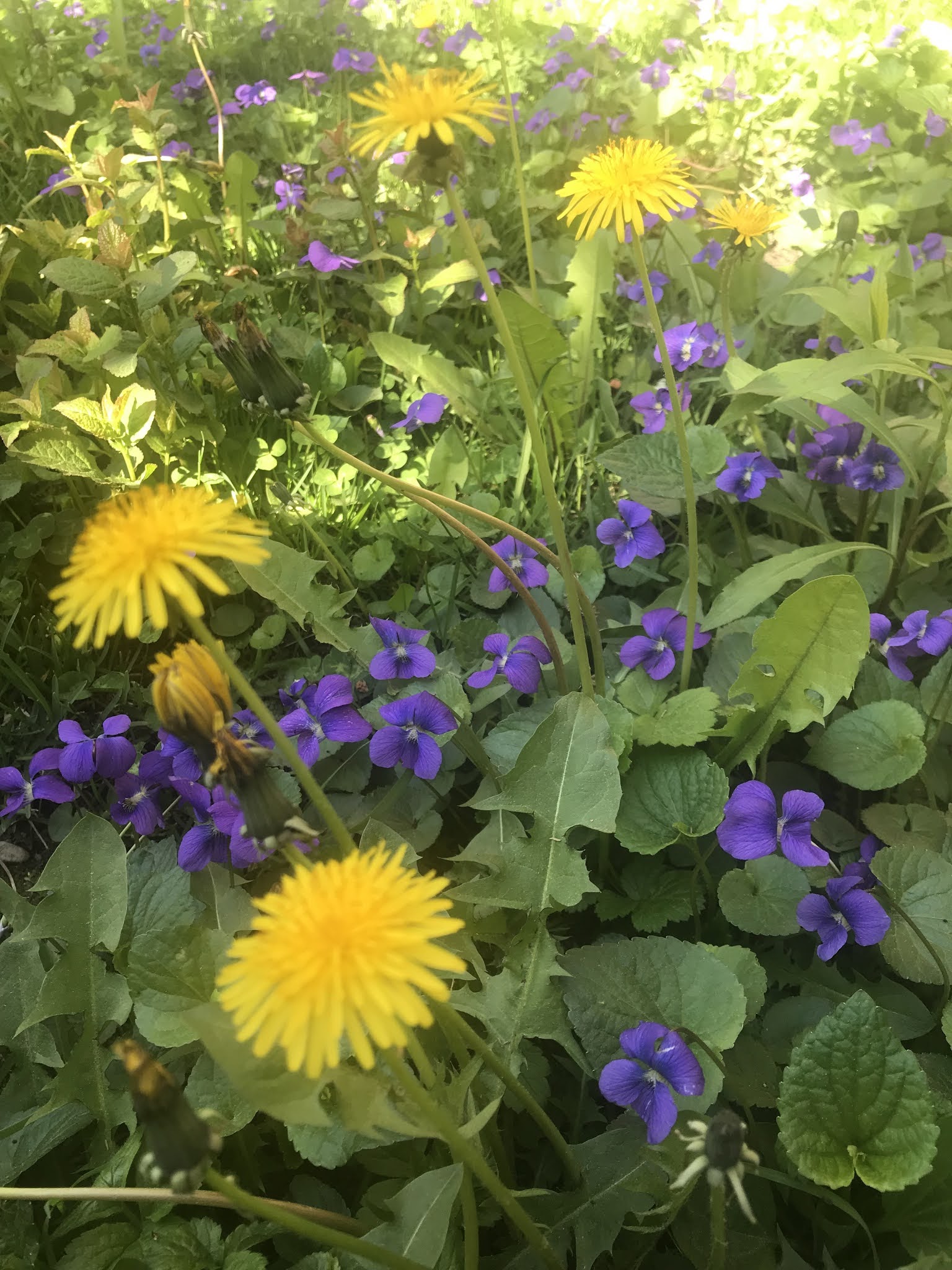
Wild violets among the dandelions
The dandelions are not alone in their enjoyment of "No Mow May."  Wild violets are taking advantage of the circumstances, as well. Like dandelions, wild violets are an important food source for pollinators. Like dandelions, the petals and leaves of wild violets are edible. Like dandelions, wild violets have medicinal uses. Like dandelions, wild violets can't shake their reputation as an undesirable and aggressive weed. The similarities are striking. 
The complementary colours of dandelion
and wild violet
Also striking, is the colour combination of yellow and purple. Opposites on the colour wheel, these complementary colours work together to create a dramatic contrast. As a result, each dandelion flower appears brighter and more vivid when it is next to the blooms of wild violet, and vice versa. It is, in a way, an unspoken partnership. With so much in common, I began to wonder if these plants might recognize something in each other: their lowly standing in the garden, their unrecognized worth, their unparalleled capacity to reproduce, and their own beauty. The result was this poem.*

The Takeover (Dandelion and Wild Violet)


Dandelion met a wild violet

in a field of green uniformity

and sensed a kindred soul mate, riotous

uncontrolled against the conformity


Deeply aware of their common status

and problematic notoriety 

they conceived a partnership of balance

commencing the takeover quietly


Life unleashed under pappus parachutes,

through rhizomes and seed-scattering ruptures 

Futures borne on cool breezes and taproots

and radiant reciprocal colours


Grass subsumed, purple and yellow replete

The annex of the lawn at last complete


Pappus are the tufts of hair on dandelion seeds
that catch the wind, helping to disperse
the seeds on the breeze  
Happy Gardening!

*This poem is written as a sonnet. An English sonnet has fourteen lines made up of three quatrains and a couplet. It follows an abab cdcd efef gg rhyme pattern. There are ten syllables per line. When I revived my garden blog, I wondered if I would have anything left to say (my original garden blog was about five years worth of posts). In trying to express my garden observations in poems, I am looking at my garden in new ways and learning lots about poetry along the way.

Wednesday, May 19, 2021

The Transformation and Trials of Magnolia "Susan"

The peak of magnolia season has come and gone. In my garden, Magnolia "Susan" spends the colder days of early spring wrapped tightly in fuzzy buds covered in fine silver-grey hairs.

A Magnolia "Susan" bud warm in 
her fur coat
Soon, she is teasing me with hints of what is to come, as her buds break open to reveal the beginnings of a dark purple bloom stubbornly clenched tight against cool spring days.

A hint of colours to come on Magnolia "Susan"
The true drama of her rich and vibrant colours is soon revealed as the sun grows stronger.
Magnolia "Susan" begins to unfurl

Magnolia "Susan" takes her time to fully open
Finally, Susan is ready for her grand finale, opening fully to reveal enormous flowers of twisted pink and purple tepals. She is spectacular—the centre of attention in the garden.   

Magnolia "Susan" in full bloom
The slow transformation—from fur-wrapped buds to gargantuan blooms—takes about a month. For a flowering tree that seems to take such care in slowly unveiling its fullest extravagance, the end comes rather quickly. Perhaps the effort of the build-up to this moment proves to be too much. Perhaps it is the shifting of attention to mass plantings of tulips, camassia, and bearded iris that are waiting to steal the spotlight. Whatever it is, "Susan" drops her showy flowers after just a few short weeks and leaves a mess of brown, decaying blossoms that need to be cleaned up.

Magnolia "Susan" drops her blooms
and leaves a mess
As I watched "Susan" through her various stages this spring, I wondered what she might be like if she were a person. The result was this poem.

Susan

I met Susan as she waited

to make her debut

A genteel lady

refined and unassuming

The definition of demure


Or, so I presumed

The fur wrapped around her shoulders

should have been a clue

It screamed

Look at me


She was captivating in purple silk

sharing stories of travels to Asia

Basking in the attention  

until the pressure of the performance 

exposed a small crack


Or, so I pretended

Her search for validation

disclosed a gaping chasm

the dormant hazard of self-doubt

I knew Susan until she fell apart


Magnolia "Susan" in snow during an
early spring storm

Happy Gardening!